
Young children are learning much more than letters, numbers and colours. They are also learning how to understand their feelings, communicate their needs, build friendships and respond to everyday challenges.
These abilities form an important part of social-emotional development in early childhood. They help children participate confidently in the classroom, cooperate with others and gradually manage their emotions more independently.
Parents and teachers can support this development through everyday conversations, predictable routines, purposeful activities and positive examples.
Social-emotional development refers to a child’s growing ability to:
Recognise and express emotions
Understand the feelings of others
Build positive relationships
Communicate wants and needs
Cooperate and share
Manage disappointment and frustration
Make age-appropriate decisions
Develop confidence and independence
These skills develop gradually. A preschool child is not expected to manage every emotion perfectly. Children need patient guidance and regular opportunities to practise.
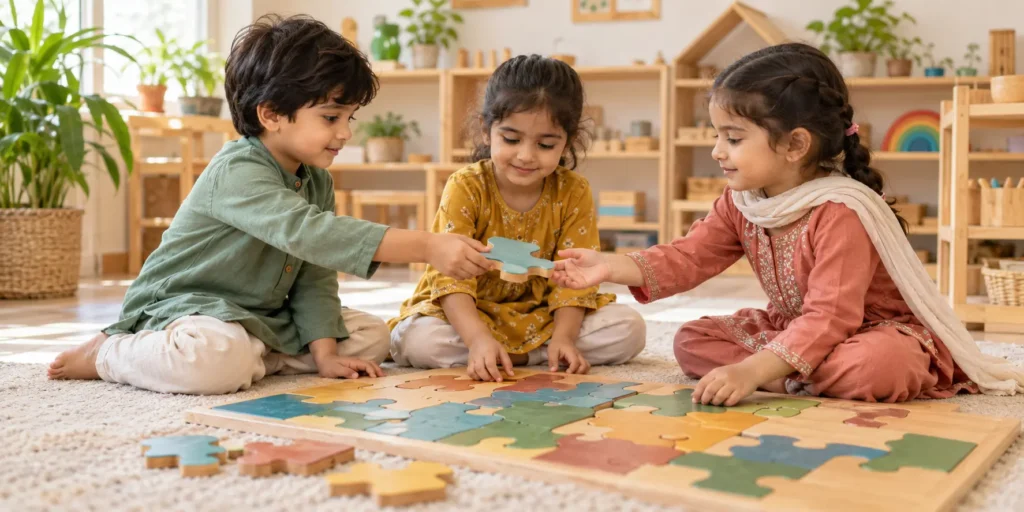
Young children often experience strong emotions without knowing how to describe them.
Parents and teachers can introduce simple words such as:
Happy
Sad
Angry
Worried
Excited
Frustrated
Calm
Surprised
When a child is upset, acknowledge the feeling before discussing the behaviour.
You might say, “I can see that you are disappointed because playtime has finished,” or “You seem frustrated because the puzzle piece is not fitting.”
Naming emotions helps children understand what they are experiencing. Over time, they can begin using words to express themselves instead of depending only on physical reactions.
Avoid telling children that they should not feel a particular emotion. Every emotion is valid, although some behaviours may still need clear limits.
Children learn by observing the adults around them.
When parents and teachers speak respectfully, listen carefully and manage disagreements calmly, children receive a practical example of positive communication.
Adults can model this by:
Saying “please,” “thank you” and “excuse me”
Listening without interrupting
Apologising after making a mistake
Speaking calmly during disagreements
Explaining feelings clearly
Treating other people with kindness
Waiting patiently for a turn
If an adult becomes frustrated, they can describe the healthy response: “I am feeling upset, so I am going to take a slow breath before I continue.”
This shows children that emotions can be managed without hiding them.
Predictable routines help children understand what will happen next.
Regular times for waking up, meals, learning, play and sleep can make daily life feel more organised. Routines are especially helpful when children are adjusting to school or another unfamiliar environment.
Prepare children before a transition by giving a simple reminder:
“We will put the toys away in five minutes.”
“After breakfast, we will get ready for school.”
“When this story finishes, it will be time to sleep.”
Visual routine cards can also help younger children follow the order of daily activities.
A routine does not need to be completely rigid. Its purpose is to provide enough consistency for children to feel prepared and secure.
Small choices give children a sense of responsibility and control.
Instead of asking an unlimited question, offer two suitable options:
“Would you like the red cup or the blue cup?”
“Would you like to read this book or that one?”
“Would you like to draw first or complete the puzzle?”
“Will you put away the blocks or the art materials?”
Both options should be acceptable to the adult.
Choices encourage children to think, communicate preferences and accept the result of a decision. They can also reduce unnecessary conflict because the child is participating in the process.
Practical responsibilities such as organising materials, preparing a simple snack and returning items to their places can further develop independence. Parents can explore these Montessori activities at home for additional ideas.
Playing with other children provides natural opportunities to practise social skills.
During cooperative activities, children learn to:
Share materials
Wait for their turn
Listen to different ideas
Ask for help
Offer assistance
Work towards a shared goal
Resolve small disagreements
Useful activities include building a block structure together, completing a large puzzle, creating group artwork or participating in pretend play.
Adults should provide guidance when necessary, but they do not need to solve every small disagreement immediately. Children benefit from having time to suggest solutions.
Questions such as “How can both of you use these blocks?” or “What could we do so everyone gets a turn?” encourage problem-solving.
Learn more about how play-based learning supports early childhood development.
Young children need practical ways to respond when emotions become overwhelming.
Calming strategies may include:
Taking slow breaths
Counting slowly
Drinking water
Sitting in a quiet area
Holding a comforting object
Drawing how they feel
Asking an adult for help
Taking a short break from an activity
Practise these strategies when the child is already calm. It can be difficult to introduce a completely new technique during an emotional moment.
A quiet area should not feel like punishment. It should be a safe place where children can settle themselves before returning to an activity.
Adults should remain calm and available while the child is learning these skills.
Stories provide a comfortable way to explore feelings and relationships.
While reading, ask questions such as:
How do you think this character feels?
What made the character upset?
What could the character do next?
How could a friend help?
Have you ever felt this way?
What would you do in this situation?
Picture books and pretend-play stories allow children to discuss emotions without feeling that they are being questioned about their own behaviour.
After reading, children can draw a scene, act out the story with toys or create a different ending. These activities support empathy, communication and creative thinking.
Emotional development does not mean preventing children from becoming upset. Disappointment, anger and worry are normal parts of childhood.
When a child experiences a strong emotion:
Remain calm and move close enough to provide support.
Acknowledge the feeling using simple language.
Maintain clear limits around unsafe behaviour.
Allow the child time to settle.
Discuss the situation after the child is calm.
Help the child consider a better response for next time.
For example: “It is okay to feel angry, but it is not okay to hit. You can tell me that you are angry or ask for some space.”
This approach separates the child’s emotion from the behaviour. It communicates that feelings are accepted while boundaries still matter.
Children benefit when home and school provide consistent guidance.
Parents can share information about situations their child finds difficult, while teachers can explain how the child communicates, cooperates and manages transitions in the classroom.
Helpful communication may cover:
Changes in the child’s routine
Activities the child enjoys
New fears or concerns
Friendship development
Progress in communication
Strategies that help the child calm down
Areas requiring additional encouragement
The purpose is not to label the child. It is to understand their needs and provide supportive, consistent responses.
Development looks different for every child, but parents may gradually notice that their child:
Uses more words to describe feelings
Waits briefly for a turn
Shows concern when someone is upset
Separates from caregivers with greater confidence
Follows familiar routines
Asks for help when needed
Recovers from disappointment more easily
Participates in group activities
Attempts to solve small problems
Takes responsibility for simple tasks
Progress is rarely perfectly consistent. A child may manage a situation confidently one day and need more support the next.
We love to Hear from you.
© 2026 Leads Schools EME Campus. All rights reserved.