
Learning to read does not begin when a child opens their first school textbook. It begins much earlier through conversations, stories, songs, pictures and everyday experiences.
Before children can read complete sentences, they develop important early literacy abilities such as listening, recognising sounds, learning new words and understanding that pictures and words communicate meaning.
Parents can support these abilities without creating a formal classroom at home. Building early reading skills at home can be simple, enjoyable and naturally included in a child’s daily routine.
Early reading skills are the abilities children develop before they begin reading independently. These provide the foundation for future reading comprehension and written communication.
They include:
Listening and understanding spoken language
Recognising and producing different sounds
Learning new vocabulary
Enjoying stories and books
Following the order of events
Connecting pictures with objects and ideas
Recognising letters and their sounds
Expressing thoughts through conversation
Every child develops at a different pace. The goal is not to force children to read early but to build their confidence, curiosity and interest in language.
Regular conversation is one of the simplest ways to support language development.
Describe everyday activities while preparing food, getting ready for school or travelling together. Ask your child about what they can see, hear or feel.
Instead of questions that require only “yes” or “no,” use open-ended questions such as:
What do you think will happen next?
Which part did you enjoy?
Why do you think the character did that?
Can you describe what you can see?
How would you solve this problem?
Give your child enough time to answer. Listening patiently shows that their ideas are important and encourages them to communicate confidently.
A short daily reading routine can help children develop a positive relationship with books.
Choose a comfortable time when both you and your child are relaxed. Ten to fifteen minutes of focused reading can be more useful than a longer session in which the child is tired or distracted.
While reading, point to illustrations, change your voice for different characters and pause to discuss what is happening. Children do not need to sit completely still to benefit from a story. They may point, ask questions or repeat familiar parts.
Reading the same book several times is also helpful. Repetition allows children to remember words, understand the story more deeply and predict what will happen next.
Children are more likely to participate when they are interested in the subject.
Allow your child to select books about animals, transport, nature, families, imaginary characters or other topics they enjoy. Their preferred book may not always be the one an adult would choose, but personal interest encourages attention and engagement.
Keep a small number of books on a low shelf where the child can reach them independently. Displaying some books with their covers facing forward can make them easier to notice and select.
Books can be rotated occasionally to maintain interest without overwhelming the child with too many choices.
Picture observation helps children develop vocabulary, attention and storytelling skills.
Before reading the written story, look at the cover and illustrations together. Ask your child what they notice and what they think the book might be about.
You can also use a wordless picture book and invite your child to create their own story. There is no single correct answer. The purpose is to help them observe details, connect events and express ideas in their own words.
This activity shows children that a story has a beginning, middle and end—an important part of reading comprehension.
Rhymes help children hear similarities and differences between sounds.
Sing nursery rhymes, repeat simple poems or play games in which you find words that sound alike. You might say “cat” and ask your child to think of a word with a similar ending, such as “hat.”
Clapping the syllables in familiar words is another useful activity. For example:
Ap-ple: two claps
Ba-na-na: three claps
El-e-phant: three claps
These playful activities help children notice how spoken words are made from smaller sound units.
Children benefit from understanding the sounds letters represent rather than memorising letter names alone.
Introduce one sound at a time using familiar objects. For the “b” sound, you could use a ball, book, button or banana. Say the sound clearly and let your child repeat it.
Avoid introducing too many letters during one session. Short and enjoyable practice is more effective than turning the activity into a test.
You can also invite your child to find objects around the home that begin with a particular sound. This connects letter learning with real experiences.
Hands-on activities can strengthen the thinking skills children need for reading.
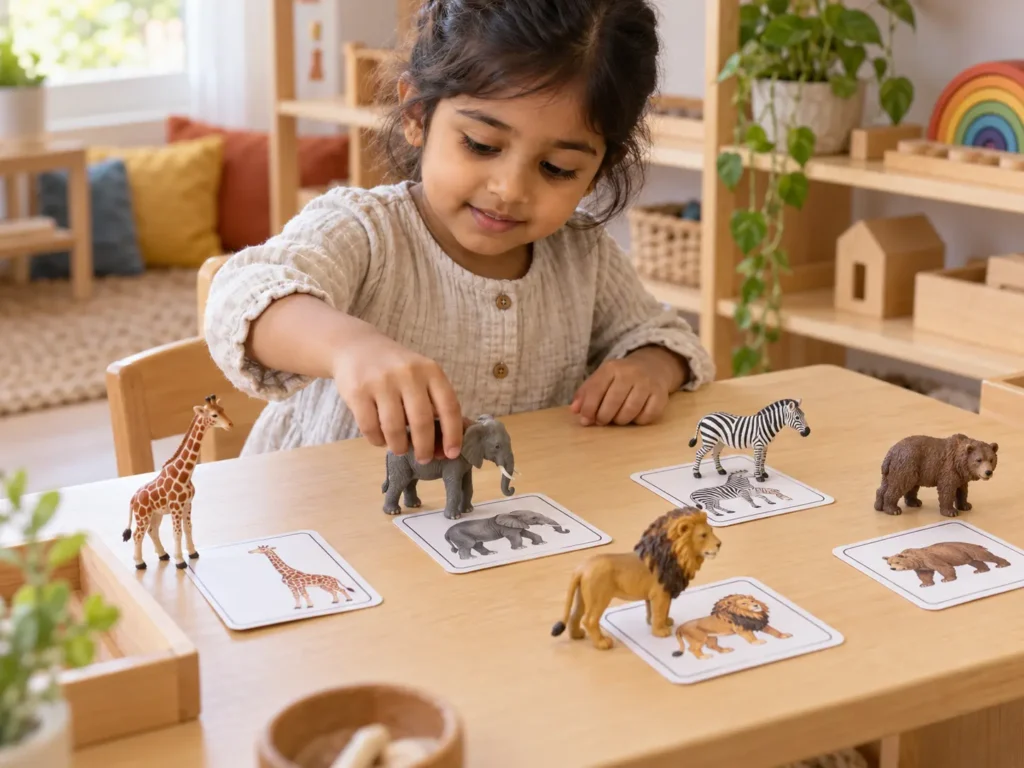
Ask your child to match small objects with corresponding picture cards. For example, they can match a toy elephant with a picture of an elephant. This develops visual recognition, vocabulary and the ability to connect symbols with real objects.
Sequencing cards are also useful. Give your child three or four pictures showing a simple event, such as planting a seed or preparing a snack, and ask them to place the pictures in the correct order.
Afterwards, encourage the child to describe what happens first, next and last.
Children learn from the language they hear and use every day.
You do not need to cover the house with worksheets or printed labels. Instead, create meaningful opportunities for speaking, listening and observing.
You can:
Tell stories about family experiences
Cook together and discuss each step
Talk about colours, shapes and sizes
Visit a park and describe what you observe
Encourage your child to retell their day
Keep drawing and writing materials accessible
Use puppets or toys to create imaginary stories
Ask your child to explain their artwork
These activities help children understand that language is useful for communicating ideas, remembering experiences and understanding the world.
A positive reading experience is more important than completing a particular number of pages.
Parents can make reading time more effective by following a few simple principles:
Choose age-appropriate books with clear illustrations.
Remove unnecessary distractions and screens.
Allow your child to turn the pages.
Explain unfamiliar words using simple language.
Connect the story with familiar experiences.
Encourage questions without interrupting constantly.
Appreciate participation rather than correcting every mistake.
Stop when the child becomes tired or frustrated.
Reading should feel like shared quality time rather than a lesson the child must complete perfectly.
Parents naturally want their children to progress, but too much pressure can reduce their interest in books.
Try to avoid:
Comparing your child with other children
Correcting every pronunciation immediately
Asking too many test-like questions
Introducing material that is too advanced
Forcing a child to finish a book
Expecting long periods of concentration
Using reading as a punishment or obligation
Gentle encouragement and regular practice create stronger learning habits than pressure.
We love to Hear from you.
© 2026 Leads Schools EME Campus. All rights reserved.