
For young children, play is much more than entertainment. It is one of the most natural and effective ways to explore ideas, practise new abilities and understand the world around them.
When children build with blocks, solve puzzles, create imaginary stories or work with their classmates, they are developing important academic and life skills. Play-based learning in early childhood combines this natural curiosity with meaningful educational experiences.
Instead of relying only on memorisation and direct instruction, it gives children opportunities to learn by doing, experimenting, communicating and solving problems.
Play-based learning is an educational approach in which children develop knowledge and skills through purposeful play.
Activities may be initiated by the child, introduced by the teacher or planned as a combination of both. The teacher prepares a safe and engaging environment, provides suitable materials, observes the children and guides their learning when necessary.
Examples of play-based learning include:
Although these activities feel enjoyable, each one can support several areas of a child’s development.
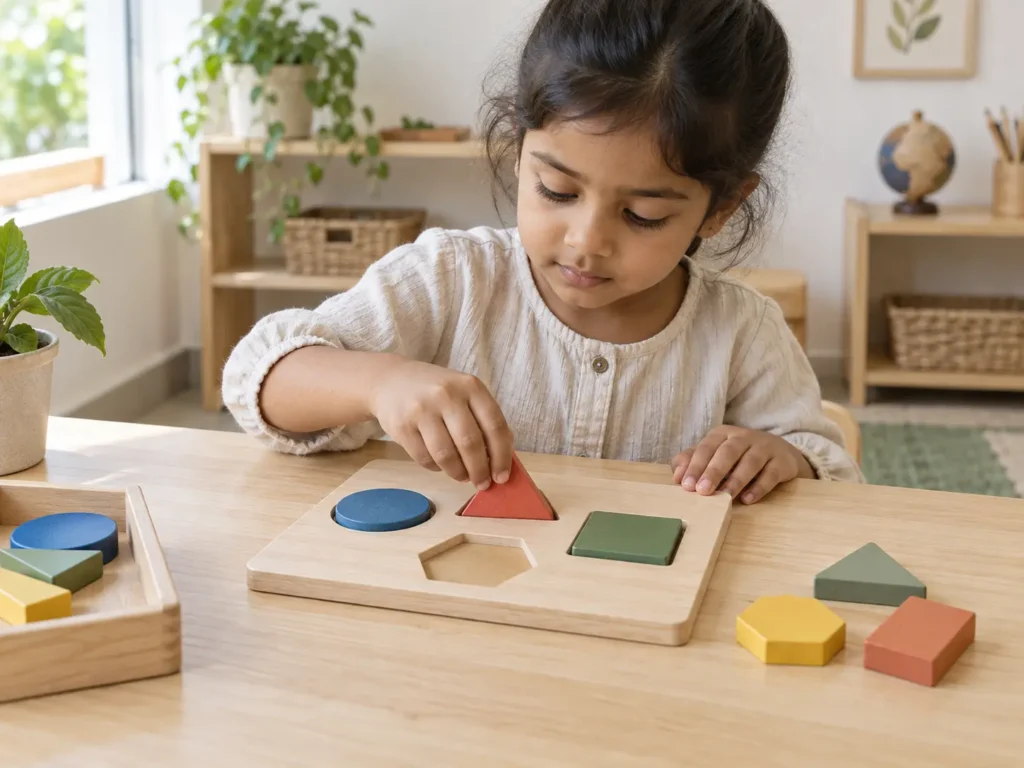
Play regularly presents children with small challenges.
A block structure may fall, a puzzle piece may not fit or a toy may need to be shared. Children must observe what happened, consider different possibilities and try another approach.
These experiences teach children that a problem does not always need an immediate answer from an adult. They can experiment, make adjustments and discover solutions independently.
This process supports logical thinking and helps children become more comfortable when facing new challenges.
Children naturally communicate during play. They explain their ideas, ask questions, describe objects and respond to other children.
During pretend play, they may create characters, assign roles and develop an entire story together. These interactions introduce new words and encourage children to express their thoughts more clearly.
Teachers and parents can support language development by asking open-ended questions such as:
Questions like these encourage conversation without controlling the child’s activity.
Playing with other children provides valuable opportunities to learn cooperation.
Children practise waiting for their turn, sharing materials, listening to different ideas and working towards a common goal. They may not always agree, but these moments help them understand how to communicate and resolve small conflicts.
Group play can support the development of:
These social abilities help children participate more confidently in the classroom and build positive relationships with others.
Open-ended play allows children to use materials in different ways.
A wooden block can become a building, a bridge, a telephone or part of an imaginary city. A cardboard box might become a house, a shop or a vehicle.
There is no single correct result during creative play. Children are free to develop ideas, test possibilities and use their imagination.
This freedom encourages flexible thinking. It helps children understand that one object, question or problem can have several possible uses or solutions.
Play-based activities can support both fine and gross motor development.
Fine motor skills involve the smaller muscles in the hands and fingers. Children strengthen these muscles when they:
Gross motor skills involve larger body movements. Running, jumping, balancing, climbing and throwing help children develop strength, coordination and body awareness.
Both types of movement are important for everyday activities, classroom participation and increasing independence.
Play gives children the freedom to make age-appropriate choices.
They may select an activity, decide which materials to use and determine how they want to complete a task. When children successfully solve a problem or create something independently, they experience a genuine sense of achievement.
Mistakes also become part of the learning process. If an idea does not work, the child can try again without feeling that they have failed a formal test.
This encourages persistence, confidence and a willingness to explore unfamiliar activities.
Young children do not always have the vocabulary to explain how they feel. Play provides another way to express emotions and understand everyday experiences.
Through pretend play, children may recreate situations involving family, school, friendships or visiting a doctor. This can help them process feelings and become familiar with situations they find new or challenging.
Playing with others also helps children recognise different emotions, respond to their classmates and gradually develop empathy.
A calm and supportive play environment gives children space to express themselves while learning how to manage their feelings appropriately.
Play-based learning does not mean children are left without guidance. Teachers have an important role in making the experience purposeful and developmentally appropriate.
An effective teacher:
The aim is to guide children without unnecessarily taking control of their activity.
Play-based learning can continue at home without expensive toys or complicated materials.
Parents can provide simple activities such as:
Give your child time to explore before offering an answer or completing the activity for them. A simple comment such as “I noticed you tried a different piece” can encourage thinking without interrupting concentration.
It is also helpful to keep a limited selection of activities organised and accessible. Too many materials at once can become distracting.
Play-based and structured learning do not need to compete with each other.
Young children benefit from a balanced educational environment that combines purposeful play with clear routines, guided activities and age-appropriate academic instruction.
For example, children may learn counting through physical objects before working with written numbers. They may develop vocabulary through stories and pretend play before completing a language exercise.
This balance makes learning more meaningful because children can connect academic concepts with real experiences.
We love to Hear from you.
© 2026 Leads Schools EME Campus. All rights reserved.