
Children learn best when they are actively involved in meaningful, hands-on experiences. The Montessori approach encourages children to explore, make choices, solve simple problems, and complete age-appropriate tasks independently.
Parents do not need expensive Montessori materials or a specially designed classroom to support this learning approach. Many effective Montessori activities at home can be created using everyday household items.
Here are ten simple activities that can help your child develop concentration, coordination, confidence, and important early learning skills.
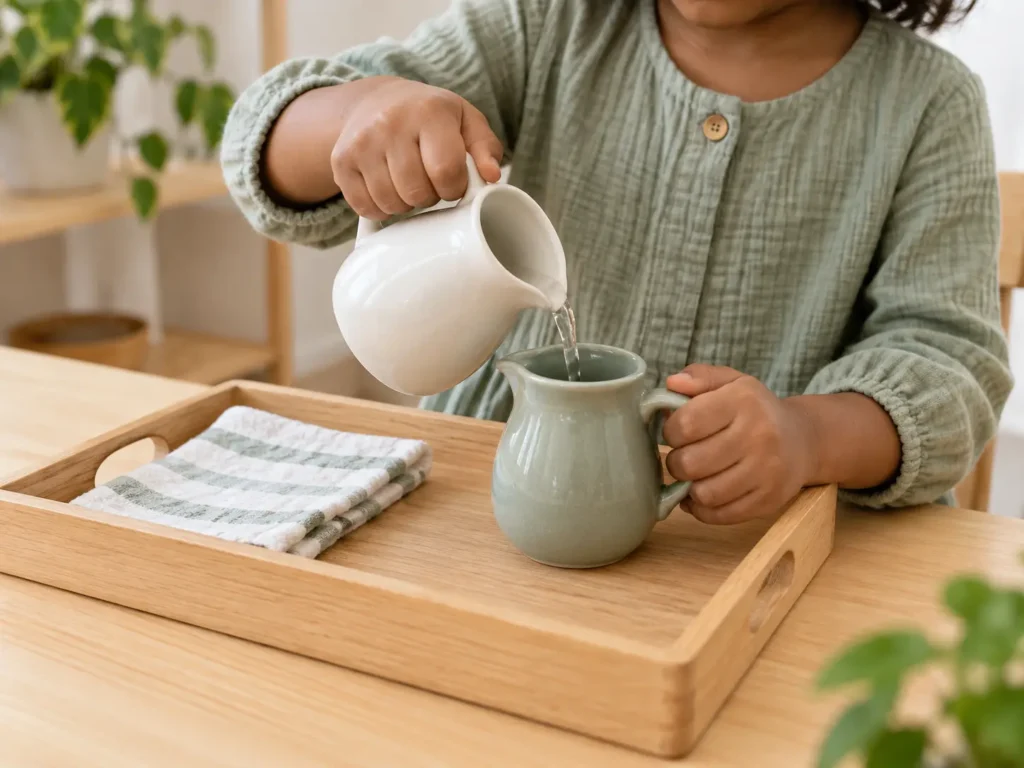
Pouring is a practical life activity that improves hand-eye coordination, concentration, and control of movement.
Give your child two small plastic jugs or cups. Fill one with a small amount of water and demonstrate how to pour it slowly into the empty container.
Place the containers on a tray to manage spills. Allow your child to repeat the activity independently rather than correcting every small mistake.
Skills developed:
Sorting helps children observe similarities and differences while developing early mathematical thinking.
Collect safe objects such as coloured buttons, bottle caps, blocks, or pom-poms. Ask your child to group them according to colour, shape, or size.
Begin with two categories and gradually introduce more as your child becomes comfortable with the activity.
Skills developed:
Place dry beans, pasta, cotton balls, or other safe objects in one bowl. Ask your child to transfer them into another bowl using a spoon.
Older children can try using tongs to make the activity more challenging. Always supervise young children when small objects are being used.
This simple Montessori activity prepares the hands for everyday tasks such as eating independently and holding writing tools.
Skills developed:
Write the numbers one to ten on separate cards. Give your child small objects such as blocks, buttons, or counters.
Ask the child to place the correct number of objects beside each card. For example, three blocks should be placed beside the number three.
This activity helps children understand that numbers represent actual quantities rather than being symbols that must only be memorised.
Skills developed:
Learning how to button a shirt, close a zip, or tie shoelaces develops independence and prepares children to manage their personal belongings.
Start with loose clothing that is easy to handle. Demonstrate each movement slowly and allow your child enough time to practise.
Avoid completing the task immediately when your child struggles. A little patience gives children the opportunity to think, try again, and experience the satisfaction of success.
Skills developed:
Collect safe natural objects during a walk, such as leaves, flowers, stones, twigs, or seed pods. Arrange the items on a tray and encourage your child to observe them.
Talk about their colours, shapes, patterns, sizes, and textures. Children can also sort, draw, or count the objects.
Nature-based Montessori learning activities help children become more curious about the world around them.
Skills developed:
Choose a letter sound and find a few familiar objects that begin with it. For example, for the “b” sound, you might use a ball, button, book, and box.
Say the sound clearly and ask your child to repeat it while touching each object. Focus on the sound of the letter rather than only its name.
This hands-on approach connects language with real objects and supports early reading development.
Skills developed:
Children enjoy participating in real household activities. With proper supervision, they can wash fruit, peel a banana, spread soft cheese on bread, or arrange snacks on a plate.
Use child-safe utensils and demonstrate each step slowly. Encourage your child to clean the work area after completing the activity.
Snack preparation teaches children that their contributions are meaningful and valued.
Skills developed:
Ask your child to help place napkins, spoons, plastic cups, or plates on the table before a meal. After eating, the child can return the items to their correct places.
Begin with one simple responsibility and add more tasks as the child becomes confident.
Practical life activities like this allow children to participate in family routines while developing organisation and care for their environment.
Skills developed:
In Montessori education, completing an activity includes returning the materials to their proper place.
Create a low shelf or clearly marked area where your child can keep toys and learning materials. Show the child how to carry one activity at a time and return it before selecting another.
A simple cleanup routine develops order, self-discipline, and respect for shared spaces.
Skills developed:
The way an activity is introduced is just as important as the activity itself. Parents can support their child by following a few simple principles:
Every child develops at a different pace. The purpose is not to complete activities quickly but to build confidence, curiosity, and a positive relationship with learning.
We love to Hear from you.
© 2026 Leads Schools EME Campus. All rights reserved.